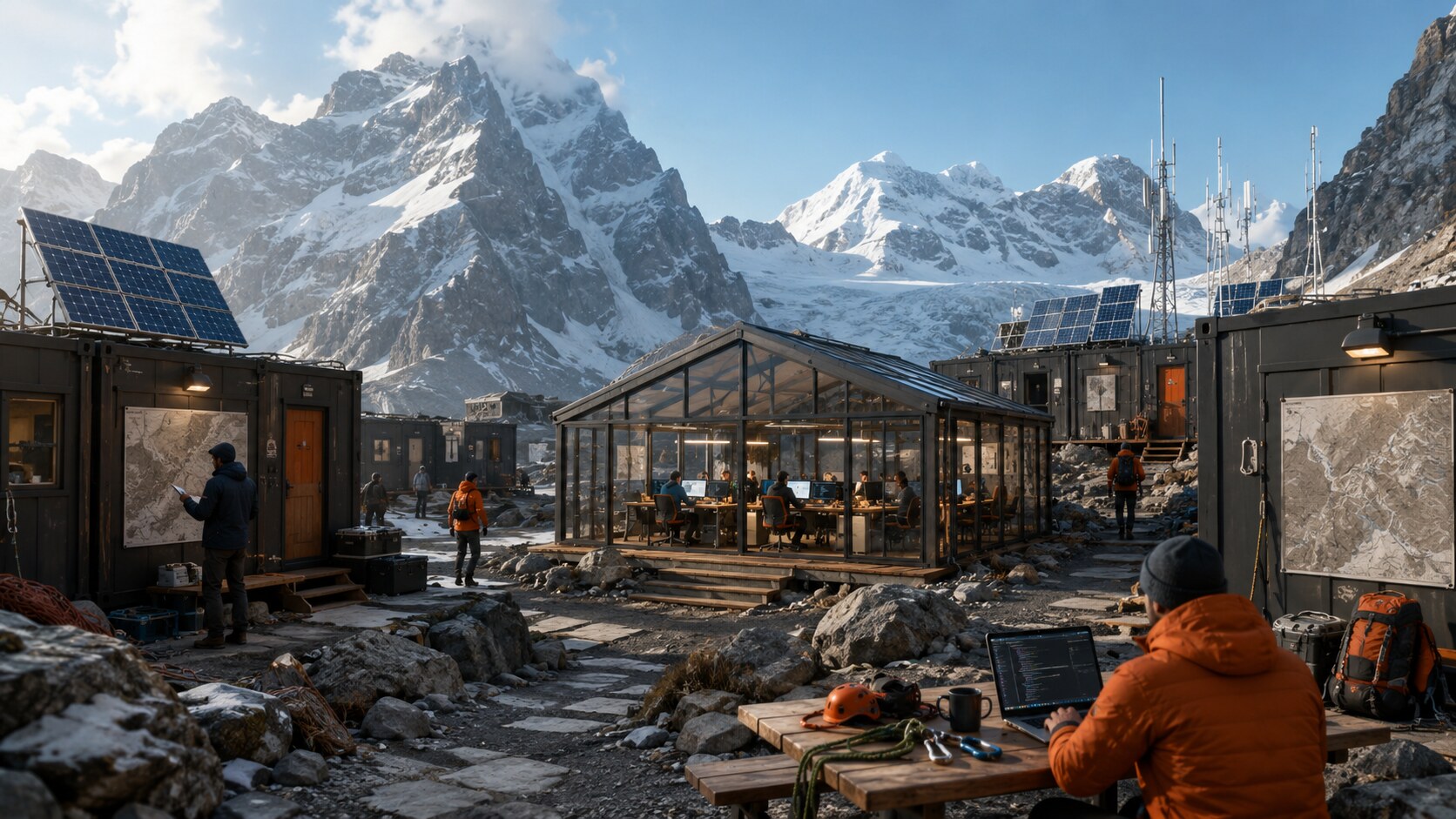
A modular software-development basecamp beneath alpine peaks

Elevation 2,140 m · Network stable · Coffee ready

Take difficult software somewhere with a horizon.

Dev Basecamps is imagined as a network of remote working camps for small technical teams that need time to understand a system, repair a difficult foundation, or design the next version without ordinary office noise.

Choose an expedition

Why leave the office?

Some technical problems are really attention problems.

A complicated codebase can accumulate more than defects. It can accumulate interrupted decisions, undocumented compromises, abandoned migrations, duplicated conventions, and fears that nobody has had enough uninterrupted time to examine. Normal work keeps the system moving, but movement is not the same as direction.

The basecamp model creates a temporary boundary around one meaningful challenge. A team might bring an aging service that nobody trusts, a release process that depends on one person’s memory, a product whose architecture no longer matches its users, or a prototype that needs to become dependable. The camp does not promise instant transformation. It creates conditions in which the real problem can finally be named.

The glass pavilion

Shared architecture work

Large diagrams remain visible for days instead of disappearing after a meeting. Teams can map data movement, system boundaries, failure paths, ownership, and unresolved assumptions. The room is designed for standing discussion in the morning and quiet implementation in the afternoon.

The repair bench

Hardware and field tools

Adapters, spare cables, test devices, power supplies, compact servers, and network equipment are organized for projects that cross the boundary between software and physical systems.

The silent cabin

Deep debugging

One desk, one large display, one notebook, and no expectation of availability. The cabin exists for the hours when a developer needs to hold an entire chain of behavior in working memory.

A day at basecamp

07:00

System weather

The team reviews overnight alerts, physical weather, and any change that could affect the day’s work. The update ends after fifteen minutes.

08:00

Primary ascent

Three protected hours are reserved for the hardest task. Messaging channels remain closed unless a genuine operational problem appears.

13:30

Traverse

Pairs compare findings, test assumptions, review changes, and decide whether the planned route still makes sense.

18:00

Camp log

Decisions, failures, commands, diagrams, and unresolved questions are recorded while context is still fresh.

01

Bring one real problem.

A basecamp is not a general retreat for catching up. The team arrives with a defined system, risk, migration, or architectural decision that deserves concentrated attention. The problem may evolve after investigation, but it must be concrete enough to guide the first day.

02

Leave a usable trail.

Every important discovery is documented for people who were not present. Diagrams, setup instructions, rollback plans, decision records, test procedures, and known limitations are treated as part of the technical outcome rather than administrative residue.

03

Return with less mystery.

The goal is not necessarily to finish everything. A successful expedition may replace a vague fear with a measured risk, identify the real migration boundary, remove a dangerous dependency, or produce a credible sequence of next steps.

The imagined result

A codebase that feels smaller because the team understands it together.

Technical confidence rarely comes from one heroic commit. It comes from shared models, repeatable tools, visible decisions, and the removal of hidden knowledge. Dev Basecamps imagines a place where those foundations can be rebuilt with enough time, enough quiet, and just enough distance from everyday work to see the system honestly.